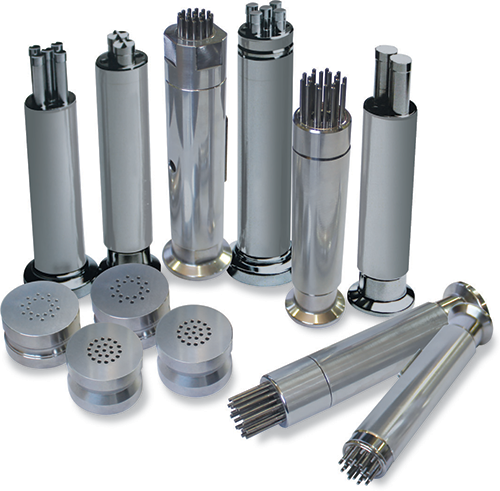
Optimizing Tablet Quality Through Advanced Punch & Die Tooling
Optimizing Tablet Quality Through Advanced Punch & Die Tooling
Precision Tooling to Enhance Compression Performance and Reduce Tablet Defects
Tablets are the most widely used oral solid dosage form worldwide, representing the majority of pharmaceutical and nutraceutical production. While tablet press technology continues to advance, the industry often underestimates the critical role of tablet tooling—Punches and Dies—despite its direct impact on the tablet compression process.
Tooling does far more than compress powder. It determines tablet geometry, logo engraving, thickness, hardness, weight uniformity, and overall visual quality. Therefore, selecting the right tooling specifications and tool-steel material properties is essential for achieving consistent tablet quality, minimizing defects, and maintaining high equipment uptime and production efficiency.
Global standards such as TSM (Tableting Specification Manual) provide dimensional and structural guidelines for Punch & Die tooling. Understanding these standards enables manufacturers to select the most suitable configuration for performance requirements and cost optimization.
Additionally, material and coating strategy is crucial in addressing common production challenges. Formulations with abrasive, adhesive, or high-moisture characteristics demand optimized tool-steel grades and advanced coatings to reduce sticking, picking, capping, and lamination, while extending tooling lifespan.
YC Punch — Precision Tooling for High-Quality Tablet Production
YC Punch delivers high-performance Punch & Die solutions engineered to improve compression reliability, enhance tablet quality, and support stable long-term manufacturing across all major pharmaceutical applications.
A. History of Tablet Tooling Standardization
The evolution of tablet tooling standards is closely tied to the industrial development of tablet compression technology. In the early years, tablet press manufacturers created punches and dies according to their own internal specifications, resulting in major differences in overall length, head profile geometry, and key orientation across brands. This lack of dimensional consistency made tooling interchangeability extremely difficult, leading to inefficiencies in production setup and increased operational complexity.
As pharmaceutical production expanded globally and specialized Punch & Die suppliers emerged, the industry recognized the need for unified standardization to ensure compatibility, reliable performance, and manufacturing efficiency.
1. TSM (Tableting Specification Manual) — North America
The American Pharmaceutical Association introduced the TSM to establish a unified reference for tablet and tooling specifications.
- Standardization of critical dimensions and tolerance ranges for punches and dies
- Unified engineering terminology and drawing conventions
- Guidelines for tablet design, troubleshooting, and tooling maintenance
The adoption of TSM significantly improved tooling interchangeability, streamlined technical communication, and enhanced production efficiency across North American tablet press operations.
2. Eurostandard & ISO 18084 — Europe
In Europe, the need for consistent tooling specifications led to the development of the Eurostandard, later expanded into a global initiative. This work resulted in the publication of ISO 18084 – Press Tools for Tablets, which defines standardized guidelines for Punch & Die dimensions, structural characteristics, and compatibility requirements.
Following multiple revisions, ISO 18084:2011 remains the primary international standard used throughout the pharmaceutical industry for tooling design and interchangeability.
YC Punch Perspective
As a specialized Punch & Die manufacturer, YC Punch designs and produces tooling based on widely accepted industry standards, ensuring compatibility with major tablet press brands. We support both standard and custom configurations, providing solutions optimized for diverse production environments.
Our structured engineering approach delivers reliable performance, reduced downtime, and consistent tablet quality, establishing YC Punch as a trusted tooling partner across pharmaceutical manufacturing operations.
B. Tablet Tooling Specifications and Structural Characteristics
Tablet tooling standards play a critical role in achieving consistent compression performance and product quality in pharmaceutical and nutraceutical manufacturing. Among the globally adopted punch & die specifications, the most widely used formats are B-Type, BB-Type, and D-Type tooling, which are primarily differentiated by barrel diameter—the section of the punch that fits into the turret.
1. Overview of B / BB / D Type Tooling
B-Type tooling is the most common standard, using a 19.05 mm (0.75 inch) barrel diameter and supporting tablet diameters up to approximately 16 mm. Due to its wide processing flexibility, it is preferred for general small- and medium-size tablet production.
BB-Type tooling shares the same barrel diameter as B-Type, but applies a reduced die outer diameter to allow more tooling positions on the turret. This enables increased output per revolution, making it well-suited for high-speed mass production of small tablets such as nutraceutical supplements and OTC products.
D-Type tooling, with a 25.4 mm (1 inch) barrel diameter, offers enhanced structural rigidity and can withstand higher compression forces. It is typically used for large-format tablets up to approximately 25 mm, or formulations requiring increased density, multi-layer structures, or challenging mechanical compaction performance.
2. Structural Differences Between TSM and ISO 18084 Standards
Both TSM (North America) and ISO 18084 / EU Standard (Europe) utilize the same basic B/D tooling framework, but structural differences impact interchangeability and operational behavior.
TSM punches typically feature an angular head shape, while ISO-standard punches use a domed head profile that ensures smoother roller contact, reducing vibration and mechanical stress at high speeds. The dome-type geometry is increasingly selected as an alternative option even in TSM-based production systems.
In addition, TSM punches generally have a thicker head and shorter working length compared to ISO designs. These differences affect dwell time, alignment behavior along the cam track, and roller loading during compression.
Due to variations in key orientation and cam track compatibility, TSM and ISO tooling cannot be interchanged without modification. Using mismatched standards may cause accelerated wear, alignment failure, or punch breakage due to improper roller loading.
Therefore, when sourcing tooling, manufacturers must confirm:
- Machine standard (TSM vs. ISO / EU standard)
- Key direction and punch orientation
- Cam track configuration
- Supplier technical documentation review
To maintain stable tablet quality and ensure reproducible compression performance, monitoring key punch & die dimensions is essential.
- Working length: distance from head flat to the base of the punch cup; affects tablet thickness, weight uniformity, and hardness.
- Cup depth: controls fill volume.
- Land width: reinforces structural durability along the tablet perimeter; prevents tip chipping and improves edge aesthetics.
- Head flat & dwell time: duration of compression; reduces capping, lamination, and hardness variation.
Aligned for Performance
Precision tooling selection and optimized punch geometry significantly elevate tablet quality, increase production efficiency, and reduce operational risk.
Tablet tooling remains one of the most critical assets affecting tablet quality and production efficiency, yet it is still often treated merely as a consumable part. In reality, achieving consistent performance and long-term manufacturing stability requires expert understanding of global standards such as TSM, as well as ensuring full compatibility between tooling and tablet press machinery.
Beyond selecting the correct standard, a strategic and data-driven approach to tooling management is essential—optimizing punch & die materials, surface treatments, and geometries according to formulation characteristics (abrasiveness, corrosion risk, compressibility) and production goals including output speed and batch volume. Systematic monitoring of key parameters such as working length, head flat, dwell time, and tip wear is critical to maintaining dimensional accuracy and enabling predictive maintenance to prevent unexpected downtime.
At YoungChang Punch, we support modern pharmaceutical manufacturing with professional tooling engineering and lifecycle management. Effective tooling strategy is not optional—it is a competitive advantage that directly impacts product quality, operational reliability, and total production cost across the entire lifecycle of tablet manufacturing.